
Shakespeare
These drugs are quick.

I fell in love with Shakespeare at Senior School when they took us to see ‘MacBeth’. They herded the whole of Year 10 into several coaches and off we went. The production we saw took place in an old church.
I came away knowing that I had seen something important - even if I understood very little; I just knew I liked the rhythm of the language and the dramatic intent. It was heady stuff.
For O’Level it was ‘MacBeth’, That cursed Scottish play and then for A’ Level it was ‘Othello’, Iago and that dreadful strangling of Desdemona.
At University I studied ‘MacBeth’ again with Joseph Milne in my spare time and in the degree course at Kent 16 plays in sixteen weeks. That was a lot of the Bard and for a while I needed a rest from Shakespeare.
Over the subsequent years my love returned and particular plays seemed to connect to me and play important parts in my imaginative life. A few weeks after my Dad passed away I saw Peter Brook’s production of ‘Hamlet’, a play about dead fathers, with Adrian Leicester in the lead role.
As a teacher I loved to teach Shakespeare and always stressed the dramatic form. If I taught it I always used drama as a tool to explore the plays and always took the pupils to see a few live productions. I taught it to Year 5 right through to A level in my eclectic career of 31 years.
At Crosfields I was also Head of Drama and there was a tradition of a BIG production annually. I built the Drama skills up with workshops, after-school clubs and theatre visits and eventually I had one particularly skilled year group. I adopted,’A Midsummer’s Nights Dream’ which they performed beautifully for three nights. The magic remains in my memory James Knight as Puck, a wonderful pupil.
I developed the following approach to Shakespeare over the years:
Three rules to deal with Shakespeare’s verse:
1. There is no subtext.
(Definition of subtext - an underlying and often distinct theme in a piece of writing or conversation.)
2. All Shakespeare’s language is transitive.
This means it travels out to an object, it always asks a question. The internal world of the imagination is being expressed outwardly.
3. Rhythm is the key to the unconscious of the character who is speaking.
This is the most important. This was my point about the language being ‘mimetic’, that the rhythm mimes the emotions of the character and gives clues to their state and motivations.
Point 3 is the most important but perhaps the most tricky to get a handle on particularly for a play like ‘The Tempest’ which is such an unusual and original play in the canon with very curious characters like Caliban and Ariel. If you wish to look at this in detail compare Prospero’s early speech when he is recounting the family history to Miranda early on and then later when he is dealing with the three men of sin. Watch how the rhythm change and reflects his inner state. Ken (from Reading) Branagh is preparing to play Prospero at the RSC soon, in light of this there was a rather good article in The Times this week asking - What sort of Prospero would he be?
I have recounted before how I acted with Ken at a shared school Drama Evening at school (he at Medway School and me at The Forest) and realised how rubbish I was compared to him. Life is made of such moments when you are young and you realise you won’t be an actor or open the batting for England.
But I did learn a great deal from reading, studying and watching Shakespeares’ plays over the years.
I learnt to have a clear sense of measure we know when it’s time to act and the time to cease from action. One of the great arts of life is in knowing when to stop. But also when to start. To avoid acting when action is necessary is the best way to destroy the opportunity to develop and achieve. Developing the habit of putting things off involves turning away from the energy given. By turning away from the energy given, less and less energy becomes available. Without that energy nothing can be done.
By accident most strange bountiful Fortune,
Now my dear lady, hath mine enemies
Brought to this shore; and by my prescience
I find my zenith doth depend upon
A most auspicious star, whose influence
If now I court not, but omit, my fortunes
Will ever after droop.
In these lines from ‘The Tempest’, Prospero, recognises that his time for action has arrived. He recognises this because of his knowledge of the stars. Through the position of these he acknowledges that his fortune will fade, not just temporarily, but for ever more, unless he takes clear and firm action, now, in this present moment.
Fortune in his terms is not financial reward, but a goddess. Her name is Fortuna, and she is the principle of chance. The wheel of fortune rises and falls. In this time of action, Prospero recognises that for him the wheel of fortune is rising and the planets are aligned in sympathy with his objectives.
Fortuna is associated with the planets of Jupiter and Venus, and though he talks about his enemies, it is the spirit of these two gods that rules Prospero’s actions. Jupiter is the god of light and of the day as well as thunder and lightning. He rules over the councils of the gods. He is the final dispenser of justice and therefore he thunders. He takes the prime site in our solar system and as such he is also associated with that other quality of justice, balance, and it is the balanced view that prevails in Prospero’s dispensation of justice. He tempers justice with mercy and performs not an act of cruel revenge upon his ‘enemies’ but a judgement which brings about rightful law under the rule of love, and in this Venus plays her inevitable part.
Our actions may not have the consequence of Prospero’s actions, the realignment of his dukedom in accordance with divine principles, but this doesn’t mean that the spirit in which he acts cannot be the same spirit in which we act, vitally alive to the present need, acting when action is possible in the spirit of reason, justice and love.
Ruled by the power of inertia, all this is impossible. If we put off the moment for action the energy is lost. Alternatively we may not so much act, but rather react, and when our reactions are ill-conceived, driven by no other motive than a personal one, the result must carry with them all the qualities of their original inception. But there is a third alternative. In rather stark terms all three are described in that source of great wisdom, the Bhagavad Gita:
Purity brings happiness. Passion commotion, and Ignorance, which obscures wisdom and leads to a life of failure.
When Purity is in the ascendant, the man evolves; when Passion, he neither evolves or degenerates; when Ignorance, he is lost.
The indication given by these verses is that to achieve something of lasting consequence in life we must do all that we can to encourage that power which is here described as Purity. Elsewhere this same power is associated with clarity, stillness and lucidity. These are the qualities associated with the mind when the light of reason rules.
Later in the Tempest Prospero says this:
Though with their high wrongs I am struck to th’ quick
Yet with my nobler reason ‘gainst my fury
Do I take part; the rarer action is
In virtue than in vengeance.
Rarer in this context doesn’t only mean unusual but also finer and nobler and more wise. It’s by these qualities that our actions must be ruled.
So that is one of the reasons I study Shakespeare because I learn from it and it contains wisdom. It also brings together a lifetime of study for me from classical myths to Hindu scriptures, everything fascinates, informs and enthrals. Study refines the mind and adds depth to our being, it is not just about passing exams and getting a job - but that is also important!
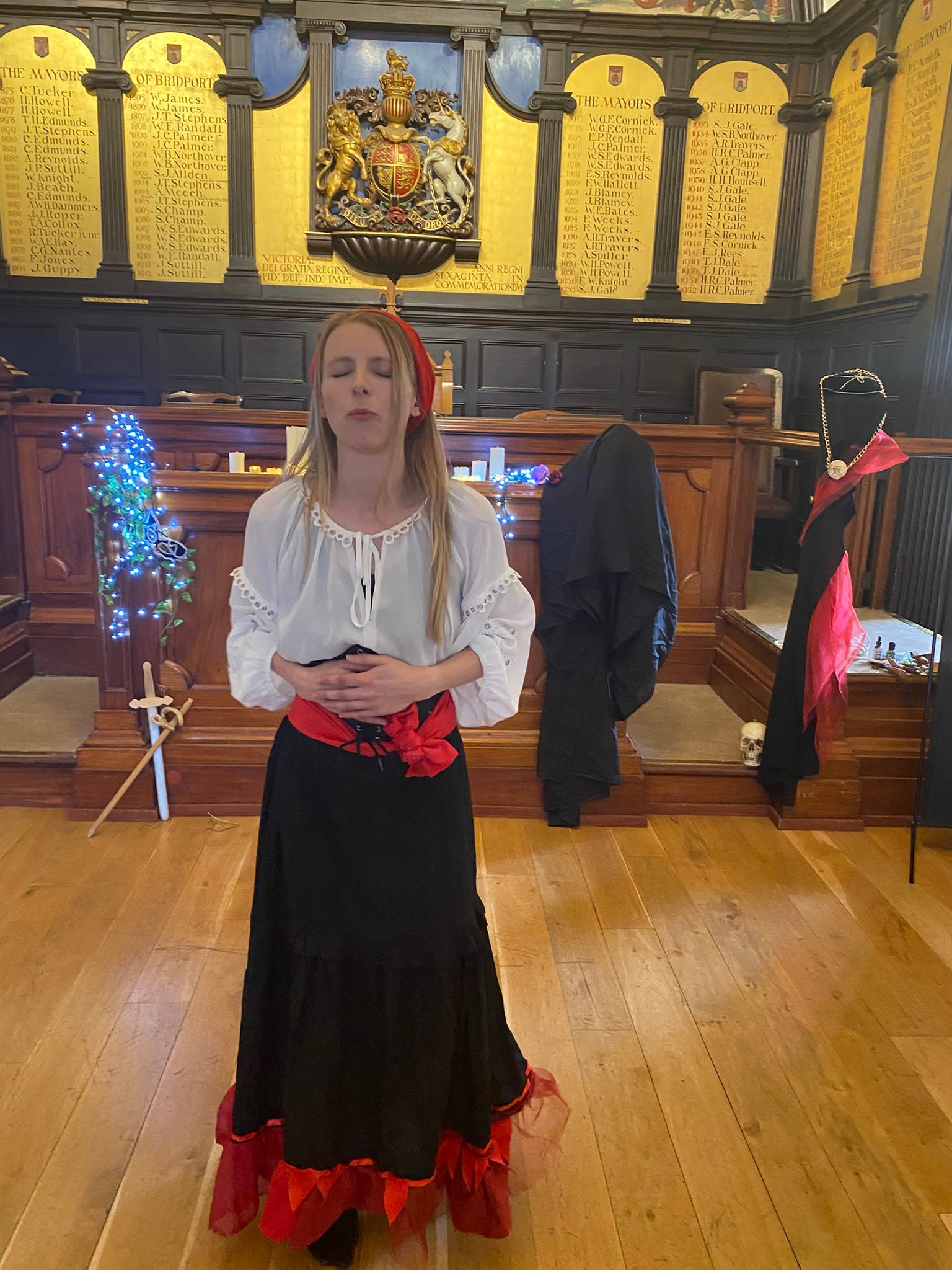
I write this now as Shakespeare has taken up a great deal of my wife’s and my time of late as last week we performed in the local Town Hall in a production of ‘Juliet and her Romeo’ adapted and directed by a lady called Valerie Goodwin who also loves the Bard perhaps even more than I do. We are the Bridport Stage Company and we are are a neuro-diverse company with a wide age range and all proceeds (£10 a ticket) go to The Samaritans. My contribution is small as I played a servant and the The Duke, but my wife had a larger role as Juliet’s mother, Lady Capulet. The production also had modern songs. The show was a sell out.
It’s curious, after all this time, being ‘inside the play’ so to speak, the magic sustains you and you are always noticing new things and shades of meaning. Shakespeare is magical and healing.
I just wish Shakespeare was well taught in schools and it should never be taught if you are not going to take children to a live performance!
@thebrazieroftruth
Play on David.